This is my labor and delivery story. I spent late nights squeezing in real-time thoughts in between nurse visits at the hospital. I'm writing this because I want it documented somewhere other than my dazed brain and a scrappy Notes app. I've gotten lazy with handwritten journals, and typing seems to be a better flow, at least for something this long. It also feels cathartic, like the right thing to do. For myself, and if I'm lucky, for someone else.
We went in for our standard 38-week check-in without much worry, because for eight and a half months everything had been on track. It was a very "no news is good news" pregnancy.
The nurse took my blood pressure which was a little high. She asked if I was out of breath or nervous. I said no, and maintained that this was standard shuffling-around-at-nine-months-pregnant activity.
She did a second reading. High again. High enough that one could be a fluke, but two was not. When my doctor arrived, she said a nice hello and promptly told me my two readings were too high, and that I'd need to go to the hospital for monitoring. If my blood pressure stayed this high, she added, I'd need to be induced.
My 35th birthday fell two days before my due date, which made this an "advanced maternal age" pregnancy. I'd been on a low-dose aspirin, preventative for preeclampsia, for most of the pregnancy and figured that was doing whatever work it needed to do, so I didn't share my doctor's sense of urgency about the hospital. I thought we'd be there a few hours, tops, and then home in time to assemble the pack-n-play and finally pick a name. Mentally, I hadn't turned on the "let's do this" button. If there is such a button.
We took the subway two stops and got to the hospital around 4:30pm. "We were expecting you," was the first thing the nurse said, which made me cock my head slightly, though I smiled anyway. I was triaged, moved to a shared room with a private section, given an IV in my hand, and hooked to an automatic blood pressure cuff that took a reading every thirty minutes.
To no one's surprise, the doctor was right. My readings kept climbing, digit by digit. I still didn't fully understand what any of it meant, especially since the numbers weren't far past the precautionary line and nowhere near critical. Naively, my husband and I were still in decent spirits, waiting for the go-ahead to go home.
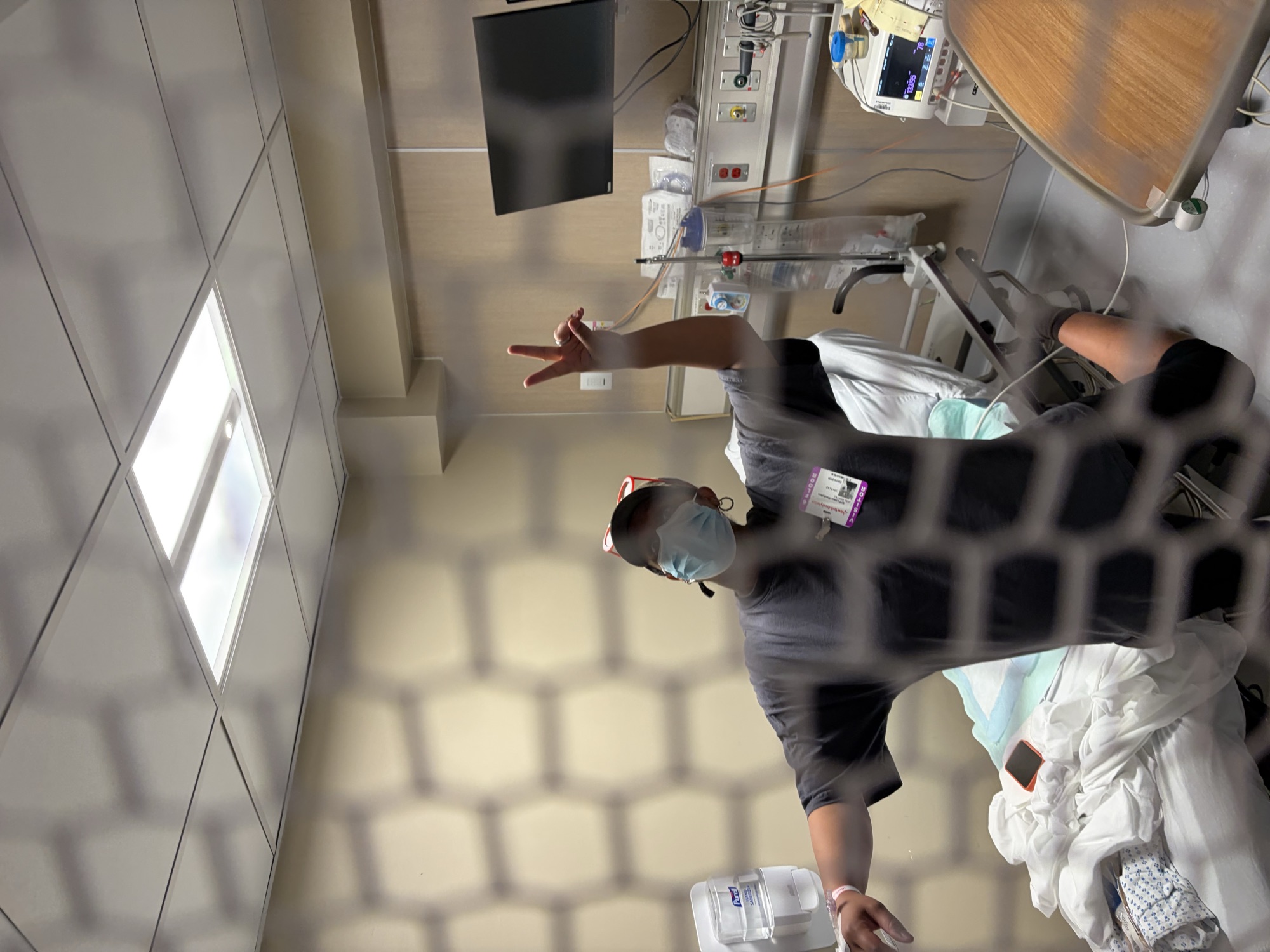
Of course that go-ahead never came. Lol.
After the third or fourth reading, the attending physician introduced herself and explained that this many high readings was a clear and immediate signal that I needed to be induced. Now. She talked through the range of high blood pressure, and while I didn't have preeclampsia, I did have hypertension. To avoid stressing the baby, induction was the only option. She asked if she could check my progress. She said a string of words that sounded like she was describing a men's suit: "Cervix is closed, but medium." Then the nurse behind her said it was time to set up a labor and delivery room.
I'd be lying if I said the reality of induction had landed. I was still in a daze, not quite believing I was having this baby soon, and that I definitely wasn't going home that night. My husband and I had labored over our birth plan assuming a vaginal delivery. The induction and c-section sections were an afterthought, filled in with vague notes from things we'd heard secondhand, because we never thought we'd need them. Now we had only the doctor's, the PA's, and the nurses' explanations, plus some Googling when they weren't looking.
But first, we needed to eat. We had planned, like we always do, to get burritos on the way home from our appointment. Between the time at the appointment, going straight to the hospital, and the few hours of monitoring, we hadn’t eaten for over four hours. My husband grabbed Chipotle while I was moved to the nicest and largest private hospital room I’d ever seen. I said “this whole thing is my room?” The nurse chuckled and said “everyone makes the same joke that this room is bigger than their apartment.” Niche New York pleasantries.
It wasn't until I was settled in the room and changed into a robe, that things started to feel real. Getting hooked up to the monitors, I noticed a bassinet in the corner. In twelve to twenty-four hours, that bassinet would hold eight pounds and some ounces of chubby cheeks and cries.
The physician’s assistant came in to review my blood pressure and told me that I just had a contraction. I was surprised because I felt nothing and also a little cocky. If I didn’t feel anything, did I need an epidural? Could I have a natural birth?? Those thoughts didn't last. I knew I wanted the epidural, and that this wasn't the moment to be rash. The anesthesiologist came by to introduce himself and mention, briefly, the strict diet I'd be on once it was in, and that I'd be tied to the bed, unable to walk. I nodded along to all of it.
At 9:45pm, once we'd finished eating, I called the care team for another check and the first dose of misoprostol, a cervical ripening agent, which officially started my induction. It was all uneventful and the PA said she'd be back at 1am for the next dose. Usually, my bedtime is 9pm (I know, I know) but I must’ve been running on pure adrenaline because I was still very much awake after the first dose. I started pacing around the room so as to not stay in the bed because I figured there will be plenty, almost too much, time for that in the coming hours.
In hindsight, I should've given more thought to bodily autonomy. On a scale from retiree on a front porch to HYROX competitor, I fall somewhere in the middle. I love a ten-mile hike and a daily two-mile loop around the neighborhood. As the pregnancy went on, I felt increasingly limited, breathing harder, taking longer to get a shoe on, unable to walk far without huffing. There were moments I felt trapped. Like I couldn't go far, couldn't run, couldn't do much of anything, physically or otherwise.
My induction called for a range of interventions, so I opted for an early epidural, before all the work started, at 7am. The epidural was also rather uneventful. It didn’t hurt, but the sensations were new. So much ice cold crawling down my back. You could tell the anesthesiologist had done this procedure thousands of times. You could tell the anesthesiologist had done this thousands of times, the efficiency of it, calling out each sensation a beat before I felt it.
Once it was in, I was on a clear liquid diet of broth, Jell-O, and crushed ice, and tethered to the bed almost literally: blood pressure cuff, catheter, an IV from the night before, two monitoring bands for contractions and fetal heartbeat. My legs, meanwhile, were going numb.
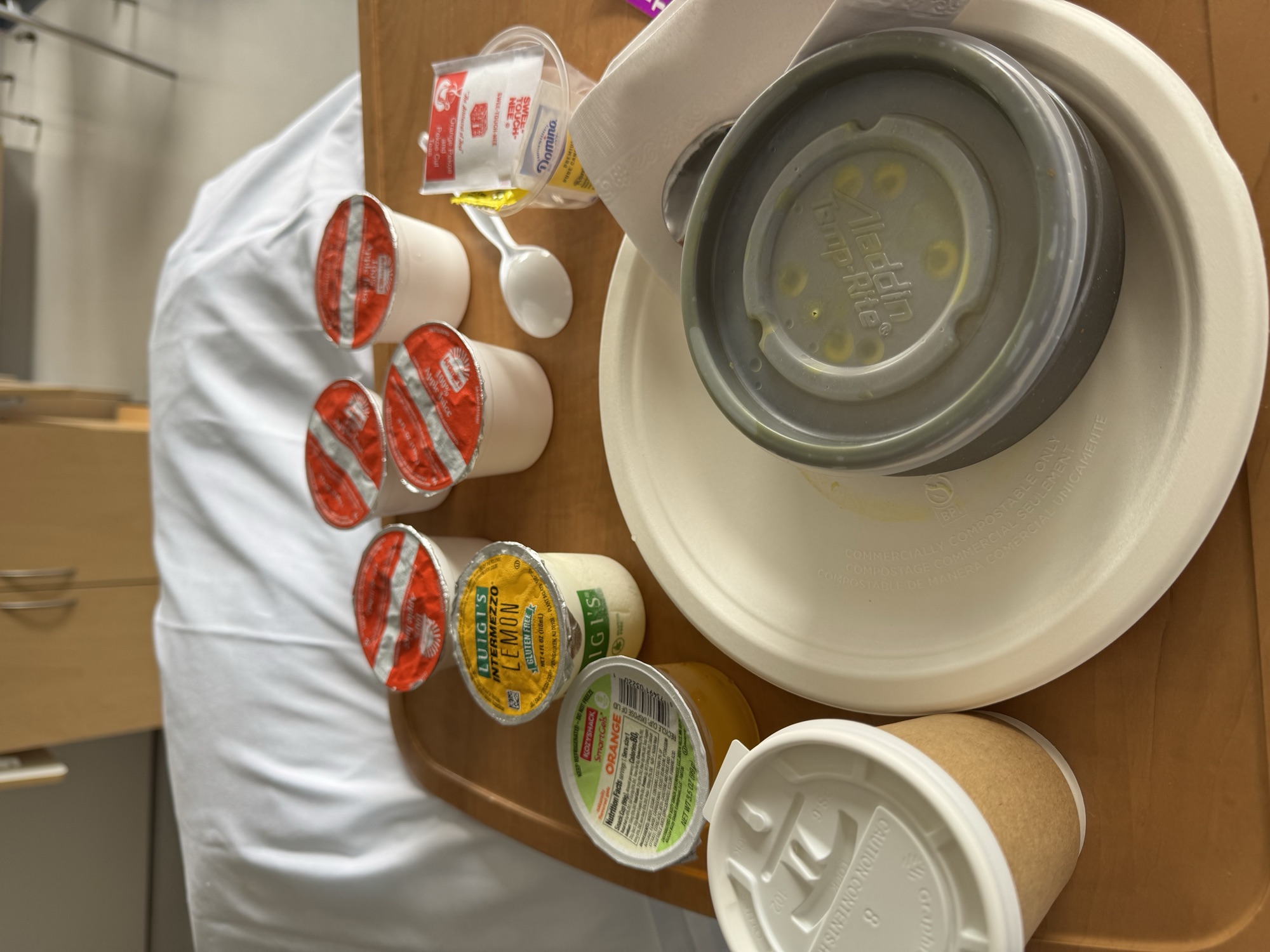
Whenever I needed to shift positions, which was often, since the baby didn't love most of them, I had to rely on what little upper body strength I had to pull myself into place for the next five minutes or hour. Eventually the nurse decided the "throne" position was best for the baby, which meant I spent most of the day looking like a season-six Khaleesi, upright, unable to sleep, watching the Food Network because you don't need volume or subtitles to follow along.
There were a few events that needed to happen for my specific induction to proceed. First, two doses of the misoprostol, then a Cook balloon, which is a device used to mechanically open and thin the cervix. I didn’t know much about inductions, but I did know that The Internet had deemed it the worst pain in the world, explaining why I opted to get an epidural beforehand. If I had to put a number on it, the full procedure time was probably 35 minutes or less, but it was the time in between, the time spent waiting for things to progress, or for a nurse to check in, or for an epidural top off to kick in. Waiting, waiting, waiting.
By 10pm, after a full day of numb legs and vegetable broth, my thoughts started working against me. It felt like a sick little merry-go-round. I can't move, as the sparkled unicorn rose. I have no control over my body, as it came back down. I'm stuck, I'm stuck, I'm stuck. I felt myself shrinking, barely responding to my husband, let alone the care team.
At 11pm, I was 10cm dilated and told to get ready to push. More than anything, I was ready to just do it. I'd already been in the hospital for twenty-four hours. I thought, “Finally, progress.”
You push during a contraction, which encourages the baby to get in its position to wiggle its way out. After the contraction the baby is supposed to recover and build up stamina for the next push. Except my baby wasn’t recovering in between. Its heart rate between contractions indicated a much slower recovery and its head remained in the same place for a while.
I don’t remember much of the pushing. I was in and out and starting to get delirious from the day. My husband was by my side, right there with the care team. It was the only thing keeping me going at this point, seeing him support me and wanting to do this together.
After an hour and a half, the doctor called it. No meaningful progress.
The baby needed to come out and we were doing a c-section. I remember two things right after: the nurses asking if I wanted to change my socks, since they might get messy in the OR, and one dramatic tear rolling down my face. I wasn't scared of the c-section itself. Instead, that tear represented twenty-four hours of trying and waiting, trying and waiting. More than anything, I felt useless.
I was wheeled to the operating room around 12:30am, and that's when everything started to unravel. I was moved from the bed I'd been in for seventeen hours onto the operating table and laid flat on my back. Within about ten seconds, I started to panic. I sat up abruptly, saying "I can't do this" over and over. My breathing went shallow and my head spun. I don't remember any faces, just maroon scrubs and white light. My husband wasn't in the room yet, and there was no one to turn to.
A nurse who'd been with me for hours came to my side and whispered that I could do this, that it would be okay, just breathe. I tried. I really did. But all I could manage was "I can't." Then the anesthesiologist sedated me, and I don't remember anything after he told me he was going to.
I do remember feeling completely embarrassed. There were at least six people in that room watching me come apart. The suffocating feeling was relentless, a free fall into somewhere dark with no solutions and total dread.
I half woke up to my husband's eyes and the ceiling of the operating room. Someone said my name, then something like "we're almost done." I asked how long, then realized I was still strapped to the table and wired up. I started whipping my arm up and down, frenzied again.
The next thing I remember is waking in the recovery room to my husband holding our baby. I drifted in and out of consciousness, but every time I surfaced, I saw him there, holding our baby, and it made me want to push through whatever I needed to, just to be there with my new family.
To say it plainly: I missed the birth of our baby. I was sedated. I never saw his first moments on earth. That remains, to this day, a kind of quiet despair. I'll never know that moment except through the photos my husband took from the other side of a plastic curtain.
Though, knowing my husband got to experience it, bringing him into the world, is the most extraordinary thing he has ever done, and I'll always hold that image as my own moment of joy, even secondhand.
When I finally came to, I got to hold our baby. I can't fully describe the cauldron of feelings in that first hold: excitement, confusion, a wave of guilt, then a wave of exhaustion, to name a few.
As we were getting ready to leave the recovery room, the nurse took our baby's temperature. High. She waited a few minutes and tried again. Still high. That's when the pediatrician was called in to tell us our son would need a few days in the NICU for monitoring, since an off reading could point to any number of things, infection among them. I was on edge again. I'd just woken up hours earlier, and now they were taking him from us again. More time apart, on top of the guilt of having missed his birth. It started to feel like a tease, like I might never get real time with him.
While our baby was in the NICU, I was moved to a new recovery room with a new set of nurses and a long list of medications. My husband squeezed in a quick nap, then went to check on the baby, sending updates along the way. Luckily, our baby was trending in the right direction: a bit of jaundice to watch, but otherwise fine, with a chance of being discharged to join us the next day. Finally, we were going to be a family for longer than ten minutes.
Because of the c-section, my hospital recovery would take longer: three nights, on top of the twenty-four hours of induction. Trapped, again.
But those days had their share of light, too. This retelling comes from notes I took in the moment, so I'm an unreliable narrator by nature, skewed toward whatever I was feeling most intensely at the time.
There was plenty of joy in there as well, and since I haven't given it much space, I want to name it directly.
The care team.
There were two shifts per day, and with each shift came a nurse, or two, a PA, and the attending physician. Across our stay, we interacted with ~eighteen staff members. Nearly all of them were, at minimum, helpful, and at their best, incredible advocates: informed, patient, remarkably supportive. I have never felt as well cared for during a medical visit as I did over those four days.
The hospital staff
Beyond the care team, there was a whole crew moving through the hospital who were generous with their time. The front desk staff who gave me an extra robe when my whole back was exposed in the hallway. The woman restocking supplies who hugged me and said congratulations to me and my husband.
My husband
Ever the trooper, ever the backbone. He ran home for supplies and clothes. He assembled the baby infrastructure we never got around to. He visited the NICU when I couldn't. He slept in impossible positions. He woke every three hours when my meds were dropped off and my blood pressure checked at 2am. He walked me to the bathroom. He refilled my water bottle. He was the first pair of hands to hold our son. Saying "Eternally grateful" feels inadequate.
When discharge day arrived, I was more than ready to go home. Oddly, it felt like graduation day. A crash course in learning and the weight of a new life ahead.
We took a Lyft home and my insides felt every single crack in the road and speed bump. A bag of marbles.
The first night was hard: confusion, delirium, impatience, desperation, all at once. Please stop crying. Please fall asleep. Please let this work. A steady stream of How do I. Being a first-time parent to a newborn feels like Diner Dash: a constant list of things to do, never in order, never the same way twice.
Four days after discharge, I got a very high blood pressure reading.
I had a feeling it was coming. My numbers had been creeping up in the days prior, never quite past the threshold they'd told me to watch for, but not great. I had strict instructions to call triage the moment I saw a high read, since it would mean going back in for monitoring.
I didn't want to. That feeling of the walls closing in came right back, and I tried to convince myself, and my husband, that it was fine, that my mood should take priority over my health. But with his encouragement, and the reminder that I had other people to live for now, I called.
And I did have to go in.
I hated walking through the hospital. I was on the same floor where, just a week earlier, I'd had a panic attack. Everything felt like a rerun of the worst parts. On top of that, I was leaving my six-day-old at home for who knew how long.
I was triaged and brought back to the same room I was in the first time. And the same set up. It was a little surreal and the worst case scenario for me.
At first, the nurse set me up for an hour of monitoring, which felt like a relief. But my blood pressure kept climbing, and after that hour I was told I'd need four more. I wouldn't be leaving before 5am at the earliest.
Around 3:30am, the PA came back and told me exactly what I didn't want to hear: I was officially diagnosed with “preeclampsia without severe features,” meaning high blood pressure plus a little protein in my urine, but none of the more serious symptoms like headaches or abdominal pain.
Because of that, they increased my prescription and ran more tests. Being diagnosed felt scary, embarrassing, frustrating, even though there was little I could have done to prevent it. I felt useless again, like my body wasn't capable of bringing another life into the world.
After the diagnosis, they gave me another pill to see if it would bring my numbers down. Luckily, they started trending down, and close to 4am the PA said she'd check with the attending about sending me home. At 5am, I was discharged and on my way back to the only place I wanted to be. Home.
On reflection, I think about how fast the ground kept shifting under me. Routine to urgent in the space of two blood pressure readings. Despair to joy in the time it took to open my eyes in recovery. I used to think gratitude was something you felt once things calmed down, once the worst had passed and you had space to look back on it.
I don't know if I think that anymore. I felt gratitude in the middle of the worst hours, right alongside the fear and frustration. Not after it.
To parenting!